This happened back when I was still in elementary school. At the time, I lived in a certain prefecture in Shikoku.
Near the housing project where I lived, there was a middle-aged guy who was infamous around the neighborhood. Everyone called him "Hekkoman."
I don't know why he was called that, but supposedly kids from generations before us had given him the nickname for fun. To put it bluntly, Hekkoman was completely out of his mind.
Rumors about him were endless—that he'd slashed kids and cats with a kitchen knife, attacked an elderly neighbor lady with a box cutter, or shoplifted from the supermarket. I was even chased by him a few times when he was wielding a hatchet. (Since it was an insular, rural village, the police were never involved.)
One summer break, being a typical mischievous kid at that age, a few friends and I decided to pull a prank on Hekkoman. Everyone was excited about the idea, and swept up in the thrill of summer vacation, we decided to test our courage by going to his house.
On the day of, three of us gathered, including myself—let's call the other two A and B. A showed up carrying an airsoft gun and a wooden sword. "Just in case!" A claimed. "You never know what Hekkoman might do!"
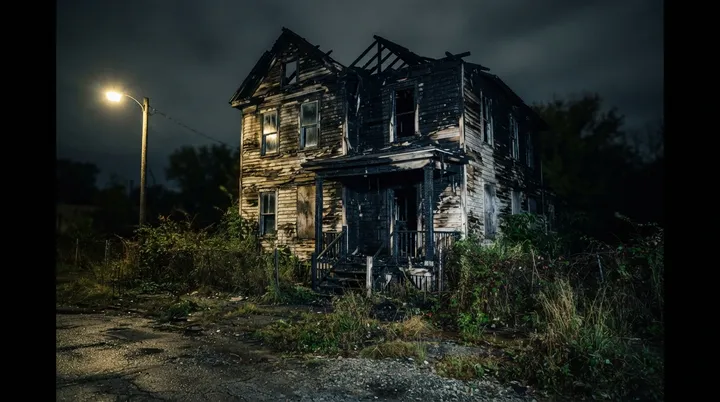
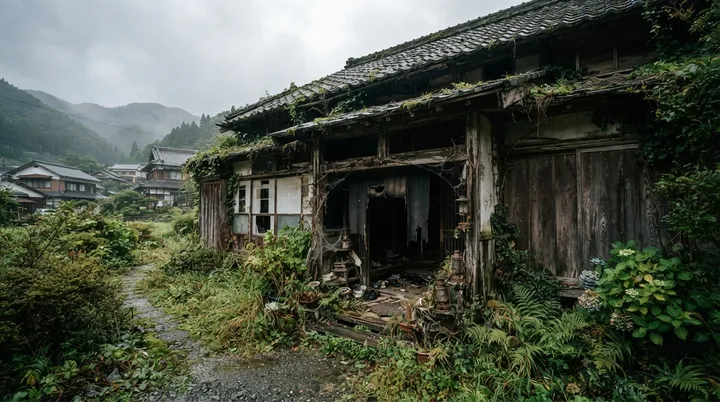
It was early afternoon and the sun was still high, so I didn't expect any supernatural scares, but the atmosphere completely changed the moment we arrived at Hekkoman's house. Built back in the early Showa era, the house had never been renovated. Part of the second-floor roof had collapsed from age, leaving the rooms inside completely exposed to the rain.
B, who was timid and hadn't been keen on going to begin with, caved almost immediately: "Maybe we should just go home?" Ignoring B, A and I teased him for being a coward and stepped through the front door.
The door was unlocked. Inside, the house was unnaturally spacious, littered with scattered junk, and smelled of damp mold. On the right side across from the entryway were stairs leading up to the second floor, but they were piled high with clutter, making them impassable. With no choice, we decided to explore the first floor and pushed deeper inside.
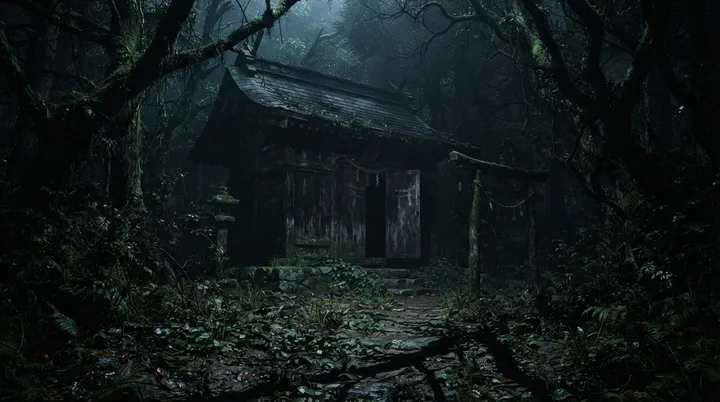
Picking our way down a hallway with barely enough room to step, we came upon a room that looked like an altar room. But where a Buddhist altar should have been, there was a crude, makeshift shrine—a large, creepy structure that looked like it had been molded out of clay by an elementary schooler. And kneeling upright in front of this shrine was Hekkoman.
We gasped in terror at Hekkoman's sudden appearance in a house that had seemed totally deserted. Yet Hekkoman ignored us, continuing to pray incessantly to the shrine, his hands joined in an unsettling, unnatural posture—as if clapping with the backs of his hands.
Looking closer at the shrine, something resembling the dried, mummified head of a monkey was laid out as an offering. Just as I was about to turn and run, A fired his airsoft gun at Hekkoman. The pellet hit him right on the back of his head with a sharp snap, and Hekkoman, who had been praying with his back to us, slowly turned around. Goosebumps broke out across my entire body, and a voiceless gasp escaped my throat.
Hekkoman had no eyes.
He stared in our direction, split his mouth into a sinister grin, dropped onto all fours like a dog, and spoke:
"You're next."
Frozen with fear, B and I were yanked along by A as we fled. We somehow made it back home, where A, B, and I were severely scolded by our parents.
We were questioned one by one and spilled everything that had happened. I thought they'd laugh at me, but I confessed that Hekkoman had no eyes. At that, the parents' faces turned pale. My parents pressed me: "You really didn't see any eyes?" B and I nodded repeatedly. Relief washed over my parents' faces—until A spoke, causing their expressions to darken once more.
A said, "I saw a dog with human eyes."
A's mother collapsed in tears, and A's father hit B and me. A Buddhist priest was later brought to A's house, while B, myself, and our families were sent home. Completely bewildered, I asked my father what was going on, but he merely said, "We're going home," and refused to answer.
About a week after that uproar, Hekkoman died. Supposedly, distant relatives held a brief direct cremation with no formal service.
Shortly after, A's family moved away, and we lost touch with them entirely. B and I grew distant after that incident as well, and we never spoke of it again.
I turn twenty this year. Last month, I visited my parents' home for the first time in a while. The subject had long been taboo within our family, so I'd never had the chance to ask, but I brought up that day to my father. What had happened to A's family? What was Hekkoman, really?
My father said, "You're twenty now. I suppose you have a right to know," and began to explain.
The area where I lived in Shikoku was once a hotbed for Inugami worship—the dog-god cult. In short, an Inugami is created by deifying the vengeful spirit of a dog to bring prosperity to a family. The method my father described for creating an Inugami was far too horrific, so I will omit the details here.
Hekkoman was the last descendant of a family that practiced this worship. As long as the Dog God was properly venerated, it brought prosperity to the family; but if the rituals stopped, a curse would strike in proportion to all that past prosperity. Simply put, the malice born from that cruel creation process turned directly onto the descendants.
Hekkoman was suffering from the curse of the Inugami. The reason his past actions never became a serious legal matter and the police never moved against him was that the fear of the Inugami curse still ran deep in this region. Thinking back, our parents and teachers had strictly warned us back then never to get involved with Hekkoman. Everyone was trying as hard as possible to avoid him for that reason.
And what A saw back then was a black dog standing behind Hekkoman. Its eyes were sickeningly human, rolling around as it stared straight at us. Once you look into those eyes, it's over. The Buddhist priest who came to A's house tried to fix things, but he himself was struck down by a critical illness and remains bedridden to this day.
A had shot his airsoft gun right at it.
After leaving Shikoku with his family, A was committed to a psychiatric hospital, where he reportedly died in agony shortly after. Soon after, his parents committed double suicide as if following him to the grave. Apparently, A's hospital room contained a black dog figurine, and his parents' house was filled with countless dog statues and plushies.
"You should be grateful to A," my father told me. "He took the whole burden with him." Because A fired the gun, he became the target of the Inugami, which saved B and me. I intend to carry the weight of A's sacrifice for the rest of my life.
Finally, why was he called "Hekkoman"?
During his life, Hekkoman had apparently tried to create an Inugami multiple times and failed. The dogs that failed turned away—hechomu in the local Shikoku dialect, meaning to look off in an odd direction. That was slurred from Hechoman into Hekkoman. (I'm keeping details vague here, as it relates to how an Inugami is created.)