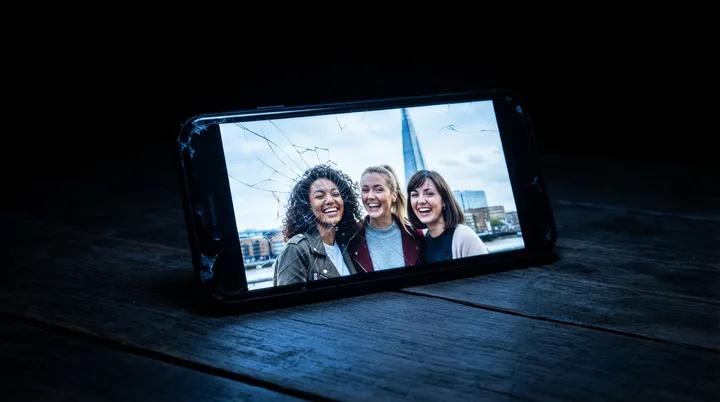
Here is a photograph.
The photo shows three young women. They were my friends from high school, and the four of us, including myself, stayed close even after graduation, meeting up for meals and taking trips together.
Even after I moved away to Kansai for college while the three of them stayed in our hometown (a certain prefecture in Tohoku), I felt a bit lonely, but we frequently kept in touch through calls and text messages.
This photo appears to have been taken on one of their trips. Standing in front of a certain landmark completed in 2012—no need to hide it, Tokyo Skytree—the three of them beam sun-kissed smiles at the camera, looking so genuinely happy that there isn't a trace of gloom about them.
I believe the original purpose of photography was to record reality. In that sense, could this photo saved on my smartphone also be considered a record of the truth?
Nowadays, however, image editing technology has become commonplace, throwing the inherent meaning of photography into question. Photos twisted through distortion, erasure, or additions may no longer depict reality, shifting their purpose into telling lies.
One thing that threatens human perception regarding the truth of photographs is the ghost photo. Showing things scientifically impossible and terrifying us—why are ghost photos so frightening?
The first reason is that the "spirits" captured in them possess terrifying appearances. With vengeful expressions and lifeless skin tones, these "spirits" usually look far from peaceful. I have never heard of a ghost photo where the spirit smiles or poses to entertain us.
The second reason is the dread of something being present that shouldn't be there—like a body part floating in midair. Conversely, there are also ghost photos where something that should be there is missing, but personally, "missing what should be there" isn't as terrifying as "presenting what shouldn't." Though I suppose that varies from person to person.
However, these two reasons are, in a sense, rationalizations after the fact to justify finding horror in ghost photos. As I've said repeatedly, while a photograph captures reality, if we who look at it sense something beyond reality, the photo's truthfulness fades far more easily than through digital editing.
As many know, human perception is so vague and fickle that three simple dots are enough for us to see a human face. No matter how accurately a photo records the truth of its subject, if human perception overwrites it, a nonexistent ghost appears. Something unthreatening becomes terrifying. To put it in cliché terms: ghosts exist within the human mind.
Here is a photograph.
The photo shows three young women. They were my friends from high school, posing with smiles in front of Tokyo Skytree.
This photograph terrifies me.
A photo I found yesterday while cleaning out my phone's camera roll, a photo I have no memory of taking, a photo whose file date reads May 2024—what on earth is this photo?
Because they died thirteen years ago. I was the only one—I was the only one in Kansai back then, and we talked about meeting up halfway in Tokyo the following year to hang out—
Who took this picture?
Why now? Why are they smiling like that, now of all times?
Why is it on my smartphone?
Back then, Tokyo Skytree hadn't even been built yet.
Is this a ghost photo?